
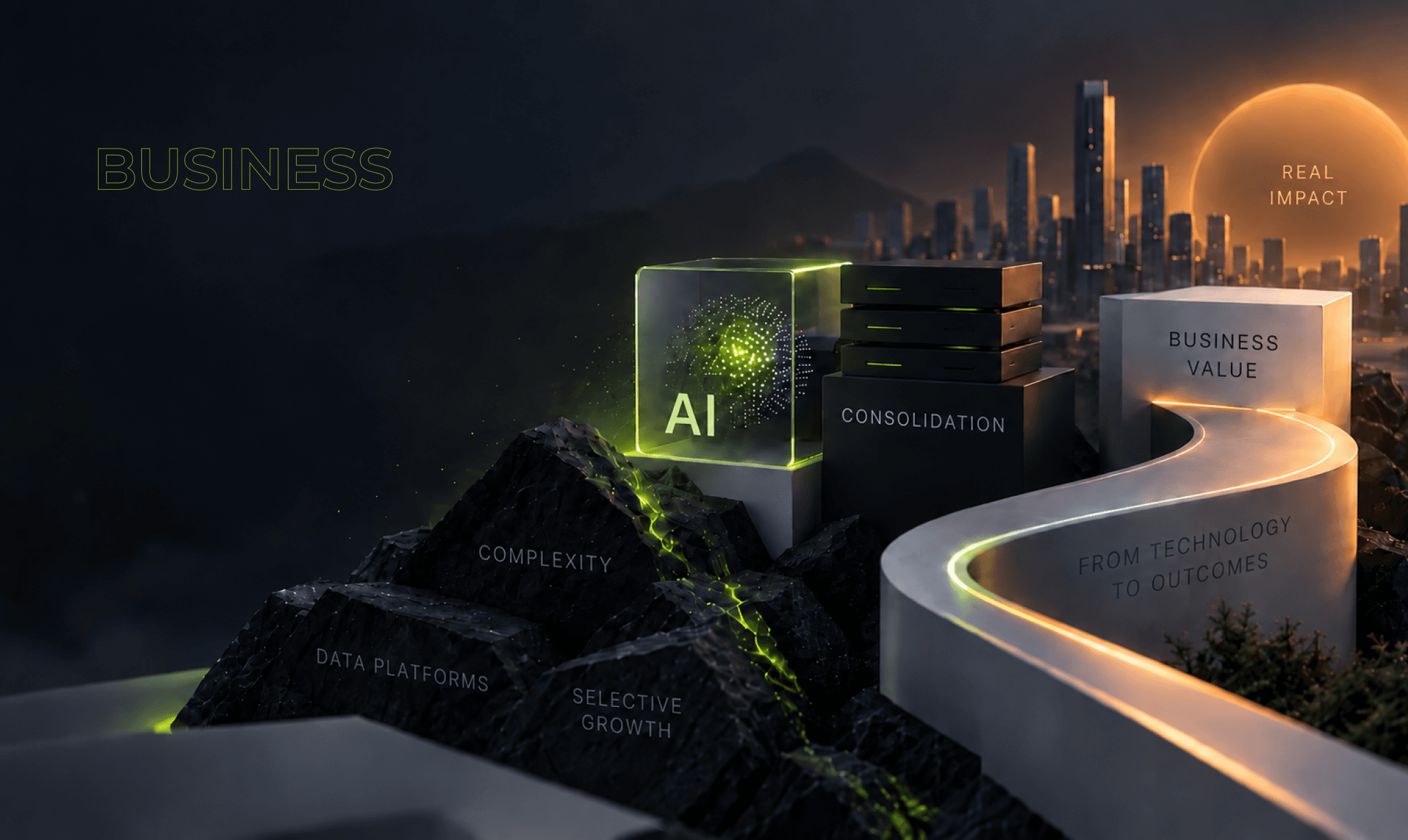
2025 marked a clear change in priorities across the technology industry.
On both sides of the Atlantic, organizations began moving away from experimentation towards scaling solutions that deliver measurable business value.
Technology spending continued to grow, but investments were increasingly assessed through the lens of return on investment, productivity and operating costs.
US vs. Europe: Two different strategies
The differences between the US and European markets became increasingly visible.
The United States focused primarily on scale and expansion of AI infrastructure, while Europe placed greater emphasis on efficiency, security and regulatory compliance.
- United States: Scale and CAPEX; Rapid AI scaling; Compute capacity
- Europe: Efficiency and governance; Selective AI adoption; Infrastructure optimization
“In 2025, the language of conversations between executive boards and technology leaders changed dramatically. There is less discussion about abstract transformation and much more focus on real productivity, the unit economics of AI queries and risk control.”
Simplifying the technology ecosystem
One of the biggest challenges became the growing complexity of IT environments.
Organizations use an increasing number of tools, platforms, and applications, creating challenges around integration, data management, and cost control.
As a result, point solutions are increasingly giving way to integrated platforms, while companies are reducing the number of technology vendors they work with.
The same trend can also be seen in mergers and acquisitions.
Although the number of transactions declined, their average value and strategic importance increased.
Organizations with distinctive capabilities in AI, semiconductors, and cybersecurity attracted particular interest.
What comes next?
In 2025, technology increasingly stopped being an area of experimentation and became part of critical business infrastructure – infrastructure that must be scalable, secure and commercially justified.
For organizations, this means answering three fundamental questions: what should we develop, what should we simplify, and where does technology genuinely create value?
These decisions will play a major role in shaping IT strategies in 2026.